
Walk down any grocery store aisle, and you’ll see jars proudly stamped with the green and white USDA Organic seal. Naturally, you assume that jar represents the gold standard: pure, untouched, local honey harvested from pristine, chemical-free flowers.
When it comes to honey, however, that label tells a very different story.
Unlike apples or spinach, bees don't stay inside a fenced-in farm. Because honey bees travel up to three miles in every direction to forage, certifying honey as "USDA Organic" is nearly impossible inside the United States—and relying on that stamp often steers you away from the purest honey available.
The Reality Behind "USDA Organic" Honey
To earn USDA Organic certification for honey, a beekeeper must prove that every single acre within a roughly 2- to 3-mile radius (over 12,000 to 18,000 acres) of their hives is completely free of synthetic pesticides, commercial farming, and treated lawns.
In the United States—especially in vibrant agricultural and desert regions like Arizona—controlling 18,000 acres of land is virtually impossible for independent beekeepers. As a result, almost all "USDA Organic" honey sold in U.S. grocery stores is imported from massive commercial operations overseas (often in Brazil, Mexico, or India).
What that label actually means for your jar:
-
Imported, Not Local: Because it comes from abroad, it doesn't contain the local desert pollens—like Mesquite, Palo Verde, and Wildflower—that support local seasonal wellness.
-
Ultra-Filtered and Heated: Imported organic honey frequently undergoes high-heat pasteurization and ultra-filtration to keep it liquid on store shelves, stripping out natural enzymes, propolis, and raw bee pollen.
-
Uncertain Traceability: Honey is one of the most frequently adulterated foods in the global supply chain. A third-party certification stamp on an imported bulk barrel rarely tells you which hive it came from or how the bees were cared for.
USDA Organic vs. Trusted Local Beekeepers
| Feature | Grocery Store "USDA Organic" Honey | Happy Bees Market Raw Local Honey |
| Origin | Almost always imported from overseas | Harvested locally from Arizona apiaries |
| Heat & Processing | Often heated and micro-filtered | 100% raw, unheated, and unfiltered |
| Pollen & Enzymes | Frequently stripped during processing | Intact raw desert pollen, propolis, and live enzymes |
| Source Transparency | Anonymous bulk supply chains | Direct from family beekeepers who manage the hives |
| Flavor Profile | Uniform, blended commercial sweetness | Distinct floral notes (Mesquite, Wildflower, Orange Blossom) |
Why Knowing Your Beekeeper Matters More Than a Stamp
When you source your honey directly from a local beekeeper you trust, you trade a bureaucratic label for real accountability.
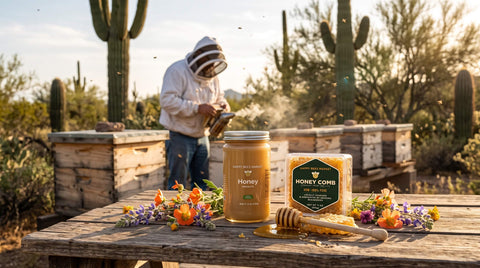
At Happy Bees Market, our bees forage across the wild, untouched stretches of the Sonoran Desert—harvesting nectar from native mesquite trees, wild sage, and desert blooms far removed from industrial row crops. Because we manage our own hives and harvest in small batches, we never need to heat, ultra-filter, or blend our honey with foreign syrups.
3 Questions to Ask Before Buying Honey
If you want truly pure honey, skip the marketing buzzwords and look for direct transparency:
-
Where are the hives located? Look for specific regional floral sources—such as Arizona Mesquite or Wildflower—rather than vague "Product of multiple countries" fine print.
-
Is it raw and unfiltered? True raw honey naturally crystallizes over time and appears slightly cloudy because it still holds microscopic flecks of honeycomb, propolis, and pollen.
-
Can you trace it back to the beekeeper? Buying straight from a local apiary guarantees the bees were ethically cared for and the honey went straight from the comb into your jar.
Taste the difference of true desert transparency.
Explore our small-batch, raw Arizona honey varieties — from rich, earthy Mesquite Honey to straight-from-the-hive Raw Honeycomb—and know the exact source behind every spoonful.

Comments (0)
There are no comments for this article. Be the first one to leave a message!